
3D Cultural Heritage: digital and material interventions in the gallery
In this blog post, DCCH Interns Keira Summersgill and Adelaide Chan reflect on their experiences of using 3D scanning and printing technologies to explore alternative approaches to material exhibitions

For its ten-year anniversary, the Treasures of the Brotherton Gallery opened with a new exhibition showcasing items from the University of Leeds’ Cultural Collections.
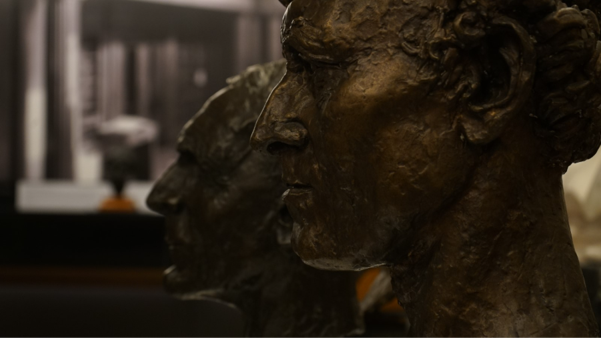
The exhibition, titled Who Am I To You?, displays statuettes and portrait busts alongside specially-made, 3D-printed replicas. These are supplemented by other materials, including ancient coins set on plaster-cast hand sculptures, and books about physiognomy which help to contextualise depictions of human heads.
Together, these ask how we might reevaluate items in the present day, and how adapting items with digital technologies affects what we see when we look at them (or handle them).

Portrait Busts

We contributed to the production of two 3D-printed busts. For these busts, we focused on digital preparation through use of Bambu Studio. This process required techniques for resizing and scaling the original 3D models.
Although this step may appear simple and technical, it had a significant impact on the outcome, as changes in scale directly influenced the physical presence and visual reading of the busts. Shifting between different scales altered how the objects related to the viewer, moving them from a massive statue to a miniature artefact.

Apart from scaling, the main concern for the production of the miniaturised versions was colour. The choice of glow-in-the-dark filament introduced a drastic change in appearance and a new way of perceiving the objects, especially under changing light conditions. What were originally formal portraits became more playful and attractive in their miniature and glowing states.

Alongside the finished pieces, there are also partial or “failed” prints for visitors to handle. These “in-progress” prints allow people to physically feel the weight, layering, and surface texture of 3D printing. It also makes it possible to see what the prints’ interiors are like.
Robert Louis Stevenson

The exhibition contains three similar statuettes. One is an original from the Cultural Collections. Two are 3D-printed, and where one of these is a replica of a statue from the Kelvingrove Art Gallery and Museum, the other is a composite. This third statuette combines most of the Leeds statuette with a head and hand (which it lacks) from the Kelvingrove statue.

To take the features of the Kelvingrove statue – based all the way in Glasgow – and get them frankensteined with the Leeds statue, both were 3D-scanned using handheld scanners. We ran the digital files through a 3D printing software called Bambu Studio, where they could be resized and divided up into small enough segments to be printed.
The Kelvingrove head and hand were kept separate from the composite’s Leeds body so that they could be printed in different colours. Whereas the other segments had joins so the statuette could be reassembled seamlessly, the Kelvingrove parts weren't contiguous with the Leeds parts and had to be made to fit after the printing.

The printing filaments were chosen to visually mediate between the bronze of the Kelvingrove statue and the stone of the Leeds statuette. We used bronze- and stone-coloured filaments to underscore the composite nature of our statuette, and the printed layer lines make it very visibly plastic.
You can read more about the project to reconstruct and reinterpret the statuettes in this article from Art UK (opens external link in new tab).
Hands and Coins

Alongside the 3D-printed statues, there is another set of less obviously contemporary items in the exhibition. The exhibition’s ancient coins are displayed on top of hands that were plaster-cast recently, and these hands belong to students at the university.
The exhibition invites visitors to interact with these items in a tactile way. EVA (ethylene vinyl acetate, an alternative to PVA) glue was used as a protective coating for the plaster, making the hands suitable to sit outside of the glass cases.

The plaster hands are heavy, in massive contrast with the super-lightweight 3D-printed pieces. The plaster proved to be very delicate, too, and some of the casts sustained fractures whilst in the gallery. Consequently, our next move was to print replicas of the plaster hands.

We started from scratch by moulding our own hands in a two-step process. First, we created moulds with moulding alginate and let them set, and then we poured the plaster into the dried moulds.

Unlike the Stevenson statues, the hands were small enough to be scanned with a rotating scanner: we plugged in a laptop, set up the software, then set the hands down one at a time on the platform and watched the scanner go.

Using this type of scanner avoided certain problems we encountered with the handheld ones, like the tendency to lose track of an object when scanning around corners.

However, we encountered other issues. There was the difficulty of getting all facets of the items into the scanner’s line of sight. (The scanner’s drawback of not seeing shiny surfaces turned to our advantage, and we solved this one with sellotape)

We took the digital files and put them into the 3D printing software we had already used for the statue replicas (Bambu Studio) for processing.
There were several hiccups with this. After trying to making the digital meshes watertight with a few different softwares, in the end we scanned the hands a second time and used the scanning software itself, EXScan, to complete and export the models.
The printed hands have a completely different feel and look to the plaster versions, even though from a distance they seem to be more or less interchangeable.

Online Environments
We also transferred the physical gallery space into a digital space. Whilst the gallery was closed, we photographed the exhibition with a 360° camera and then uploaded the images to an app (Matterport) which constructed the 3D environment for us.
A bit like Google Street View, this required a large number of photographs and careful consideration for the distances between them. Our first attempt, which involved putting the camera on top of the glass display cases, made the virtual space difficult to navigate. We rectified this, on a second attempt, with the help of a tripod.
In the same way that the 3D scanning and printing made the cultural collections items in the display cases more accessible, converting the physical space into a digital space opens up opportunities to share the exhibition with people who cannot visit in person.
As we learned repeatedly throughout the project, any conversion from one medium into another also creates new ways of viewing, and thinking about, a subject.
